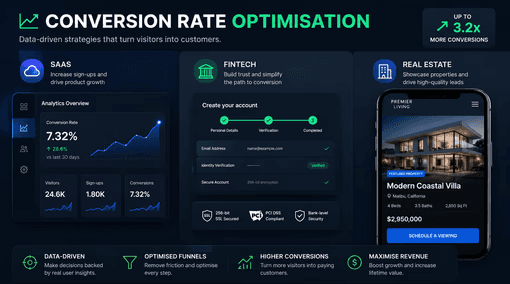
Why Blue Is the Most Powerful Color in SaaS and Fintech Web Design
There's a reason Stripe, PayPal, Wise, Revolut, American Express, Samsung Pay, and hundreds of the world's most trusted digital finance and software products all lean on blue.
It's not a coincidence. It's psychology — and it directly impacts whether a visitor trusts your product enough to sign up, invest, or hand over their card details.
The Psychology Behind Blue
Blue is the only color that consistently communicates trust, competence, and security across cultures. Multiple studies in color psychology confirm that blue reduces perceived risk — which is exactly the emotion standing between your potential user and the signup button.
For SaaS and fintech companies, that's everything.
Your visitor is being asked to trust you with their data, their workflow, or their money. Blue tells their subconscious: this is safe, this is serious, this is built by people who know what they're doing.
No other color does that as reliably.
Why SaaS Companies Specifically Reach for Blue
SaaS products face a unique challenge — they're often selling something invisible. You can't hand a user your product to touch or try before they commit. The website is the product, at least in the mind of a first-time visitor.
Blue bridges that credibility gap.
When a founder or team lead lands on a SaaS homepage, they're subconsciously asking: Can I trust this with my team's data? Will this still be around in two years? Does this company know what they're doing?
A well-executed blue palette answers yes to all three before a single word is read.
Compare that to red — urgency, aggression, risk. Or yellow — energy, but also caution. Or green — growth, but also inexperience when used poorly. Blue is the only color that walks into the room and immediately communicates professional competence.
Why Fintech Needs Blue More Than Anyone
Fintech is trust at scale. You're asking people to connect their bank accounts, move their money, or manage their financial life through your platform. The stakes are higher than almost any other digital product category.
Look at the brands that have earned massive user trust in fintech:
Stripe — deep, confident blue that communicates engineering precision
PayPal — navy that's been building trust since 1998
Revolut — dark blue as the foundation of a premium fintech brand
American Express — the blue card is one of the most recognized trust symbols in financial services globally
None of this is accidental. Fintech companies spend enormous amounts on brand research and they keep arriving at blue because it works.
For a new or growing fintech startup, leaning into blue isn't playing it safe — it's speaking the visual language your potential users already associate with financial security.
The Different Blues and What They Signal
Not all blues are equal. The shade you choose communicates different things:
Deep navy — Authority, stability, premium positioning. Works well for enterprise SaaS and wealth management fintech. Signals that you've been around and you know what you're doing.
Bright electric blue — Energy, innovation, forward-thinking. Works well for growth-stage SaaS and consumer fintech targeting younger audiences. Signals that you're modern and fast moving.
Soft sky blue — Approachability, clarity, openness. Works well for SaaS products built around simplicity or fintech trying to demystify finance for everyday users.
Blue-green (teal) — Trust plus freshness. A popular choice for fintech companies trying to differentiate from the traditional banking association of pure navy while still maintaining credibility.
Choosing the right shade is as important as choosing blue at all.
How to Use Blue Without Looking Generic
The risk with blue is that it's popular — which means it's easy to look like everyone else. The goal is to use blue intentionally, not just because it's expected.
Use blue as your trust anchor, not your entire palette. The most effective SaaS and fintech brands pair blue with a sharp contrasting accent — white space, a warm neutral, or an unexpected secondary color that creates energy. Blue grounds the brand, the accent color gives it personality.
Apply blue to your highest-trust touchpoints. CTAs, pricing pages, testimonial sections, security badges, and social proof elements — these are the moments where trust is most critical. Blue concentration at these moments does the psychological work where it matters most.
Let your shade say something specific. Don't just pick a default blue. Choose a shade that speaks to what makes your product different. An AI-powered fintech tool for enterprise banks should feel different to a personal finance app for students — both might use blue, but the specific shade, saturation, and application should tell completely different stories.
Don't be afraid of dark. Dark navy backgrounds with white type and blue accents create a premium, sophisticated feel that's particularly powerful for high-ticket SaaS and serious fintech products. It signals that your product is built for professionals who take their work seriously.
What Happens When You Get It Wrong
Ignoring blue's power doesn't make you differentiated — it often makes you look untrustworthy to the exact users you want.
A fintech startup that leads with aggressive red looks like it's trying to create urgency around your money. A SaaS tool that relies entirely on pastel greens and pinks might look beautiful but struggles to communicate the enterprise-grade reliability a decision-maker needs to see before buying a company-wide subscription.
This doesn't mean every SaaS or fintech company must use blue. It means that if you're going to move away from it, you need an intentional reason and a way to replace what blue was communicating — because that trust signal still needs to exist somewhere in your brand.
The Bottom Line
Color is not decoration. For SaaS and fintech companies it's one of the most powerful conversion tools on your website — and blue is the most effective single color in your toolkit for communicating the thing your users need to feel before they sign up, subscribe, or trust you with their finances.
Use it deliberately. Use it strategically. And choose the right shade for what your product actually is.
Because in the 3 seconds a visitor decides whether to stay or leave your site — color speaks before your headline does.
At Clausen Studio we build premium websites for SaaS, fintech, and luxury real estate brands where design directly impacts trust and conversion. If your website isn't communicating the right things in the first 3 seconds, let's talk.